










Harlan Crow net worth 2026 is estimated at $3.1 billion. Explore his real estate empire under Crow Holdings, political donations, the Clarence Thomas controversy, Dallas mansion, and the Crow family wealth legacy.
Harlan Crow — Quick Facts 2026
| Full Name | Harlan Rogers Crow |
|---|---|
| Date of Birth | 1949 (Dallas, Texas) |
| Nationality | American-Kittitian |
| Net Worth (2026) | ~$3.1 Billion (estimated) |
| Annual Income | ~$270 Million (estimated) |
| Primary Source of Wealth | Real Estate (Crow Holdings) |
| Company | Crow Holdings (Chairman) |
| Assets Under Management | ~$29 Billion |
| Dallas Mansion Value | ~$55 Million |
| Political Affiliation | Republican / Conservative Donor |
| Education | University of Texas (BBA) |
| Spouse | Kathy Crow (2nd wife) |
| Children | Rob Crow, Jack Crow, Sarah Crow |
| Father | Trammell Crow (Real Estate Legend) |
| Notable Controversy | Gifts to Justice Clarence Thomas (2023) |
When people talk about old-money Dallas power, the name Harlan Crow comes up quickly. He is not a tech billionaire who built an app overnight. His story is slower, deeper, and in many ways more American — a son who inherited an empire, nearly lost it, and then rebuilt it into something even more formidable. As of 2026, Harlan Crow’s net worth is estimated at approximately $3.1 billion, making him one of the wealthiest real estate figures in the United States. But beyond the numbers, his story involves Supreme Court justices, Republican politics, an extraordinary Dallas mansion filled with historical artifacts, and a family legacy stretching back generations.
Harlan Crow Biography: From Dallas to Billionaire Status
Harlan Rogers Crow was born in 1949 in Dallas, Texas — the third son of Margaret Doggett Crow and the legendary real estate developer Trammell Crow. His father, once described by Forbes magazine as the “largest landlord in the United States,” laid the groundwork for what would become one of America’s most recognizable real estate dynasties. Growing up surrounded by property, development, and wealth, it was almost inevitable that Harlan would follow in his father’s footsteps — though the path was anything but smooth.
He attended Randolph-Macon Academy in Front Royal, Virginia for high school, before enrolling at Emory University in Atlanta. He later transferred to the University of Texas, where he earned a Bachelor of Business Administration. His academic choices reflected a practical, business-focused mind rather than an academic one, and he entered the workforce quickly.
Harlan began his career in 1974 as a leasing agent at Trammell Crow Houston Industrial, gaining hands-on experience in commercial real estate from the ground up. By 1978, he had moved into management, overseeing Dallas Office Building operations for the Trammell Crow Company. From 1986 to 1988, he served as President of Wyndham Hotel Company, broadening his experience into hospitality. Then, in 1988, he took the helm at Crow Holdings — and that is when everything changed.
Harlan Crow Real Estate: Building the Crow Holdings Empire
When Harlan Crow took over Crow Holdings in 1988, the company was in rough shape financially. Rather than selling off assets or retreating, he doubled down. He expanded into property management services, diversified the portfolio, and began a disciplined strategy of long-term commercial and residential development that would take decades to fully mature.
Today, Crow Holdings is a private investment firm based in Dallas, Texas, managing approximately $29 billion in assets and employing close to 500 people. The company spans commercial, residential, retail, and industrial real estate across the United States. In 2011, it registered as a Registered Investment Advisor, and by 2018 it had crossed $10 billion in assets under management — a number that has since nearly tripled.
Key milestone: In 2013, Harlan launched Crow Holdings Industrial, developing distribution and fulfillment facilities. The division has since developed over 30 million square feet of industrial space for major tenants including Amazon, LG, Whole Foods, and Williams-Sonoma.
One of the most celebrated real estate projects under Crow’s leadership is Old Parkland — an exclusive office campus in Dallas built on the grounds of what was once a historic hospital, the first brick hospital in Texas, built in 1913. After purchasing the property in 2006, Crow transformed it into a prestigious urban campus that today serves as a sought-after address for private family offices, high-net-worth individuals, and wealth managers. The project is widely considered a masterpiece of combining historical preservation with modern commercial development.
Beyond industrial and commercial real estate, Crow Holdings’ portfolio includes hospitality assets, retail properties, and luxury residential developments. The firm’s revenue can approach nearly $1 billion annually, cementing Harlan’s standing not as a passive steward of inherited wealth but as an active, strategic operator.
Harlan Crow Net Worth 2026: How Big Is the Fortune?
Estimating a private billionaire net worth is always an exercise in educated approximation, but multiple financial analysts and business publications place Harlan Crow’s 2026 net worth at roughly $3.1 billion. This figure reflects his equity in Crow Holdings, long-term real estate holdings across multiple states, a substantial stock portfolio estimated at around $900 million, approximately $1 billion in cash equivalents, and a significant alternative investment portfolio that reportedly includes around $60 million in cryptocurrency.
Wealth Breakdown (Estimated)
| Asset Category | Estimated Value |
|---|---|
| Real Estate & Crow Holdings Equity | $1.2B+ |
| Stock Portfolio | ~$900M |
| Cash / Liquid Assets | ~$1B |
| Crypto Investments | ~$60M |
| Retirement Savings | ~$120M |
| Art, Collectibles & Personal Property | Undisclosed (significant) |
His annual income is estimated at around $270 million, derived from distributions, investment returns, and operating profits across the Crow Holdings portfolio. Unlike the dramatic swings of tech billionaires, Crow’s wealth is rooted in compounding real estate equity — the kind that grows steadily and resists short-term volatility.
Harlan Crow Dallas: The $55 Million Mansion and Its Secrets
If you want to understand Harlan Crow as a person, look at his home. His Dallas, Texas residence is estimated to be worth around $55 million and it is as much a private museum as it is a house. The property features ten bedrooms, 12 bathrooms, a swimming pool, a golf course, and a tennis court — but the interiors tell a far more interesting story.
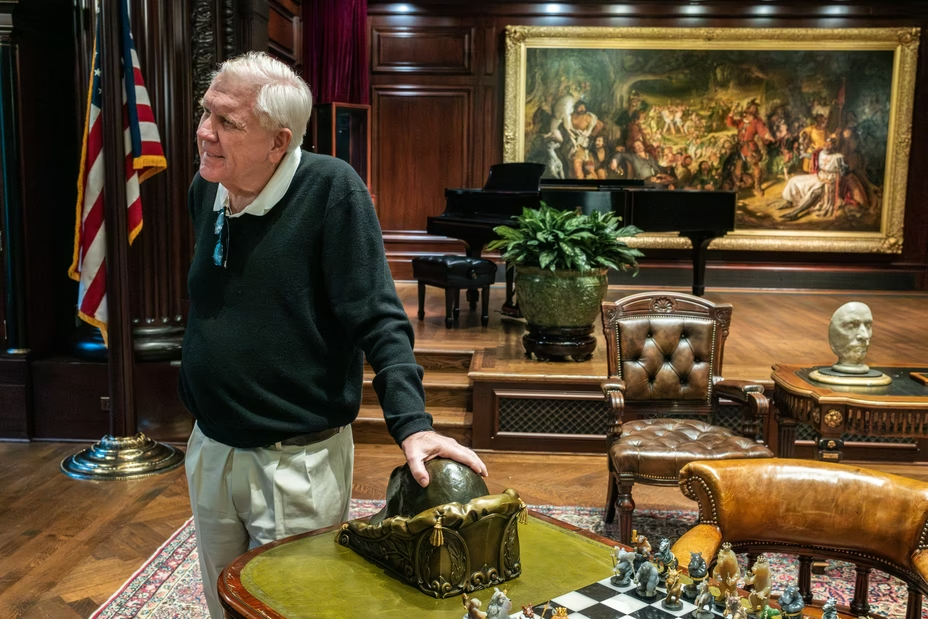
Crow’s home is filled with extraordinary historical artifacts and Americana. During a rare home tour conducted for a local Dallas newspaper, he revealed some of the collection’s treasures, including a 1493 pamphlet based on Christopher Columbus’s hand-written letter to King Ferdinand, and William Pierce’s handwritten notes from the Constitutional Convention of 1787. These are not reproductions. They are original artifacts that belong in the Smithsonian, displayed quietly in a Dallas living room.
The estate also contains an impressive art collection spanning classical and contemporary works, vintage automobiles, and an expansive superyacht that reflects a lifestyle of absolute exclusivity. Crow also recently acquired citizenship in St. Kitts and Nevis through the country’s citizenship-by-investment program in 2012 — a move that attracted attention from investigative journalists over concerns about potential use of the island’s banking secrecy laws.
Harlan Crow Clarence Thomas: The Controversy That Shook Washington
No profile of Harlan Crow in 2026 can avoid the story that turned a relatively low-profile Dallas billionaire into a national headline. In April 2023, ProPublica published a bombshell investigation revealing that Crow had provided lavish gifts and experiences to Supreme Court Justice Clarence Thomas over more than two decades — and that Thomas had not disclosed them on mandatory financial disclosure forms as required by federal law.
The two men reportedly met in the mid-1990s, and their friendship grew steadily through the years. Crow invited Thomas as a guest at the prestigious Bohemian Grove summer gathering as early as 1997. Over time, the gifts escalated significantly. They included multiple luxury vacations aboard Crow’s superyacht, with Thomas and his wife joining island-hopping trips and international travel. Thomas also accepted private jet travel and stays at private resorts.
Among the most symbolically significant gifts was a $19,000 Bible that once belonged to Frederick Douglass — a present that, given Thomas’s stature as one of the most prominent Black conservatives in America, carried obvious personal meaning. Crow’s foundation also donated $105,000 to Yale Law School, Thomas’s alma mater, specifically for a “Justice Thomas Portrait Fund.”
The most legally fraught element came when ProPublica reported that Crow had quietly purchased property in Savannah, Georgia, that was partly occupied by Thomas’s mother — essentially buying real estate from a sitting Supreme Court Justice, a transaction that requires mandatory disclosure under federal law. Crow stated his intent was to eventually convert the home into a public museum honoring Thomas. In the meantime, Thomas’s mother continued living there, and an architecture firm received permits for $36,000 in improvements shortly after the sale.
Crow’s official position: He has publicly maintained that he has “never sought to influence Justice Thomas on any legal or political issue” and that all gifts and hospitality were personal in nature, extended as part of a genuine 25-year friendship. Justice Thomas echoed this, stating he had been advised early in his tenure that such personal hospitality from close friends without business before the court was not reportable.
Legal experts cited by multiple outlets disagreed, arguing Thomas’s non-disclosure violated both the spirit and letter of judicial ethics rules. The controversy prompted the Judicial Conference to update its disclosure guidelines in March 2023, requiring justices to report private jet travel and stays at commercial properties. The episode remains one of the most discussed judicial ethics controversies in recent American history.
Harlan Crow Political Donations: Funding the Conservative Movement
Harlan Crow’s political influence extends well beyond his friendship with a single justice. He is one of the most significant conservative donors in the United States, with a track record of financial support that stretches back decades. He is a co-founder of the Club for Growth, the influential free-market advocacy organization that has shaped Republican primary races nationwide, and a board member of the American Enterprise Institute.
Over the years, Crow has donated nearly $5 million to Republicans and conservative causes. His support accelerated when George W. Bush began his presidential campaign, and he has remained active through multiple election cycles. He is also a member of the National Rifle Association’s board of directors and the all-male Bohemian Club.
What makes Crow’s political giving slightly unusual is its occasional bipartisanship. According to reporting by The New Republic, Crow has also donated to the centrist organization No Labels, and his contributions include donations to conservative Democrats such as Kyrsten Sinema, Joe Manchin, Josh Gottheimer, Henry Cuellar, and others. His political philosophy appears to prioritize fiscal conservatism and market-friendly governance over strict party loyalty, though his primary giving pattern remains heavily Republican.
Harlan Crow Family Wealth: The Trammell Crow Legacy
To truly understand Harlan Crow’s wealth, you have to understand his father. Trammell Crow, who founded the Trammell Crow Company in 1948, was one of the most consequential real estate developers in American history. Forbes called him the “largest landlord in the United States” — a title earned by building commercial developments, trade marts, and industrial parks from Texas to the entire nation. The company eventually became one of the largest commercial real estate development firms in the country.
Harlan, the third of five children, inherited both financial assets and institutional knowledge. He served as chairman and CEO of Trammell Crow Company before striking out with Crow Holdings. His wife Kathy — a Princeton alumna with an MBA from the Cox School of Business at Southern Methodist University — is herself a respected philanthropist and academic trustee. Together, in 2014, the couple donated $5 million to SMU to build the Kathy Crow Commons.
Their three children — Rob, Jack, and Sarah Crow — represent the next generation of a family that has been at the center of Dallas business and civic life for three-quarters of a century. The Crow family’s influence on the Dallas-Fort Worth area through philanthropy, real estate development, and civic engagement is difficult to overstate.
Philanthropy and Cultural Stewardship
Beyond politics and business, Harlan Crow has invested significantly in cultural and educational institutions. He founded the Harlan Crow Library, a private collection of rare books, manuscripts, and historical documents that reflects his deep passion for American history. His charitable giving to Dallas-Fort Worth area organizations has been consistent and wide-ranging, spanning arts institutions, educational endowments, and historical preservation projects.
His philanthropy is genuine but not without its complexities — the gifts to Clarence Thomas blurred the line between personal generosity and institutional influence in ways that critics argue were inappropriate regardless of intent. Still, his track record as a patron of history and culture is substantial and sincere.
More Read
Final Thoughts: What Harlan Crow’s Story Tells Us
Harlan Crow is not the kind of billionaire who makes the news for disrupting industries or launching rockets. He built his fortune the old-fashioned way — through commercial real estate, patient capital, family legacy, and disciplined long-term thinking. His estimated $3.1 billion net worth in 2026 is the product of decades of strategy, not a single breakthrough moment.
What makes his story compelling — and controversial — is how his private wealth intersects with public institutions. His friendship with Clarence Thomas raised legitimate questions about the boundaries between personal relationships and judicial independence. His political donations have helped shape conservative policy for a generation. And his Dallas mansion, stuffed with relics of American democracy, reflects a man who is genuinely fascinated by the country whose institutions he also seeks to influence.
Whether you view Harlan Crow as a generous patron, a behind-the-scenes power broker, or simply a very successful businessman who got caught in the spotlight, one thing is clear: few private citizens of his generation have had as much quiet, structural influence on American public life.